
IVF candidacy depends on more than how long you have been trying to conceive. Age, ovarian and sperm findings, reproductive anatomy, previous treatment, general health, and the safety of pregnancy all shape the decision. By the end, you will know when to seek an assessment, which records and tests matter, and how to judge whether IVF is suitable, safe, and likely to help.
Key takeaways
- Seek assessment after 12 months under 35, six months at 35–39, or promptly at 40+.
- Known fertility problems justify assessment before waiting periods end.
- Compare IVF with ovulation treatment, IUI, surgery, or donor options.
- Plan for medicines, monitoring visits, consent forms, and multiple treatment decisions.
When should you seek an IVF suitability assessment?
Seek an IVF suitability assessment after 12 months of trying if the woman is under 35, after 6 months at ages 35 to 39, or promptly at age 40 or older. Do not wait for these time points when a known fertility problem exists.
Seek earlier assessment for:
- Blocked or damaged fallopian tubes
- Ovulation disorders
- Endometriosis
- Diminished ovarian reserve
- Recurrent pregnancy loss
- Unexplained infertility
- Very low sperm count, poor sperm movement, abnormal sperm shape, failed IUI, or a need for surgically retrieved sperm
Who is eligible for IVF depends on both partners’ medical findings. The evaluation includes ovulation, ovarian reserve, uterine and tubal health, semen analysis, age, and previous treatment. IVF eligibility in Zirakpur follows medical suitability and India’s Assisted Reproductive Technology (Regulation) Act, not a separate local threshold.
Under the Act, an intending woman must generally be 21 to 50 and an intending man 21 to 55, using a clinic registered under India’s ART system.
Legal eligibility does not promise success. A person can qualify but have a low expected live-birth chance because egg number or quality has declined, while another may need treatment before IVF is safe. Ask the clinician to separate eligibility, safety, prognosis, and treatment choice rather than giving one yes-or-no label.
What findings make IVF suitable for male and female infertility?
A normal menstrual cycle does not prove that ovulation, egg quality, fallopian tubes, uterus, or sperm are normal. An IVF suitability assessment therefore examines both partners rather than assuming infertility is female-factor.
Clinicians review medical history, previous pregnancies and treatments, ovulation and menstrual function, semen analysis, pelvic ultrasound, tubal assessment, and uterine evaluation. Female assessment may include AMH, antral follicle count, and, when indicated, day-2-to-5 FSH and estradiol. Age and egg quality matter alongside ovulation, endometriosis, uterine health, and fallopian-tube status.
Low AMH or a low antral follicle count usually predicts fewer retrieved eggs or a weaker stimulation response, not impossible pregnancy.
IVF for male and female infertility changes with the cause. Very low sperm count, poor movement, abnormal shape, failed IUI, or a need for surgical sperm retrieval can support IVF.
ICSI may inject one sperm into each egg during IVF when sperm numbers or function make standard fertilisation unlikely; it does not correct the underlying male cause.
Use this checklist to identify findings that may support IVF:
- Female: blocked or damaged tubes, severe endometriosis, ovulation disorder, reduced ovarian reserve, or age-related loss of egg quality.
- Male: repeated abnormal semen analysis, severe sperm-factor infertility, failed IUI, or surgically retrieved sperm.
- Either partner: unexplained infertility, recurrent pregnancy loss, or relevant medical history after simpler options are assessed.
Is IVF the right first treatment for your diagnosis?
IVF is not automatically the best first step after infertility is diagnosed. An ivf suitability assessment should match the treatment to your diagnosis, age, ovarian reserve, sperm findings, uterine health, and pregnancy safety.
| Option | What it involves | When it may fit |
|---|---|---|
| Timed intercourse | Intercourse around ovulation | Ovulation and tubes are normal, with no major sperm problem |
| Ovulation medication | Medicines to induce or improve ovulation | Ovulation is irregular and pregnancy is otherwise safe |
| IUI | Prepared sperm placed inside the uterus | Mild male-factor infertility or selected unexplained infertility |
| Corrective surgery | Repairing tubes, removing a polyp, or treating a cavity problem | A correctable abnormality is causing infertility |
| IVF | Eggs and sperm are combined in a laboratory | Both tubes are blocked, endometriosis is severe, male-factor infertility is severe, sperm is surgically retrieved, or reproductive time is limited by age |
| Donor treatment | Donor sperm, eggs, or embryos | Using your own gametes is unsuitable or medically unsafe |
| Fertility preservation | Freezing eggs, sperm, or embryos | You need to delay childbearing or face fertility-threatening treatment |
IVF may be reasonable earlier for these indications, but treating a correctable condition or trying a simpler option may offer a better risk-benefit balance. Delay IVF for untreated uterine abnormalities, active infection, unresolved endocrine disease, or pregnancy that is medically unsafe.
Recurrent pregnancy loss and unexplained infertility do not automatically disappear with IVF; ask for a diagnosis-specific prognosis, including expected live-birth benefit, rather than only confirmation that you qualify.
What can make IVF unsafe, delayed, or less likely to work?
An IVF suitability assessment may postpone treatment when pregnancy or ovarian stimulation is unsafe, or when a correctable problem could reduce the chance of success. A legal right to treatment does not remove these medical checks.
1. Treat untreated infection, uncontrolled diabetes, thyroid disease, severe hypertension, serious cardiac disease, kidney disease, or another condition that makes pregnancy high risk before stimulation. Clinicians review blood pressure, HbA1c or glucose results, thyroid tests, kidney and liver function, medicines, and specialist opinions.
2. Disclose smoking, alcohol use, every medicine or supplement, previous chemotherapy, and abdominal or pelvic surgery. These details can change stimulation doses, anaesthesia planning, sperm or egg advice, and embryo-transfer timing.
3. Age-related declines in egg number and quality affect embryo development, miscarriage, and chromosome-related risk; no single age guarantees success or failure. Your ovarian reserve, previous response, and goals guide the plan, including whether donor eggs deserve discussion.
4. Evaluate untreated polyps, large submucosal fibroids, adhesions, or congenital cavity abnormalities before transfer. Ultrasound, saline sonography, hysteroscopy, or other imaging can show why an apparently normal uterus is not yet transfer-ready.
One failed cycle does not prove IVF cannot work. The next plan may change stimulation, fertilisation, embryo selection, transfer timing, or the decision to treat another condition first.
What happens at an IVF consultation in Zirakpur?
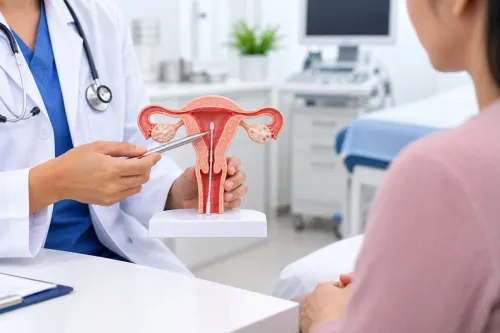
An IVF consultation in Zirakpur starts with histories from both partners: trying time, pregnancies, miscarriages, illnesses, medicines, surgeries, and previous fertility treatment. The clinician reviews records, examines when needed, and orders cycle-timed tests such as day-2-to-5 hormones or ovulation assessment alongside non-cycle-timed semen analysis, AMH, ultrasound, and tubal or uterine evaluation.
Bring:
- Semen reports
- AMH and hormone results
- Ultrasound scans
- Tubal-test reports
- Operative notes
- Miscarriage records
- Medication lists
- Previous IVF or IUI cycle details
The consultation should compare expectant management, ovulation medication, IUI, corrective treatment, or IVF where appropriate. Ask whether success rates mean a started cycle, egg retrieval, embryo transfer, or live birth; how many embryos are recommended; and the risks of ovarian hyperstimulation syndrome and multiple pregnancy.
Also ask about cancellation criteria, embryo freezing, genetic-testing indications, and backup plans.
Compare clinics on these practical standards:
| Standard | What to check |
|---|---|
| ART compliance | Registration and regulatory compliance |
| Laboratory | Embryology standards and quality controls |
| Care access | Consultant availability, emergency support, and counselling |
| Costs and consent | Itemised stages, transparent fees, and written informed consent |
Kore Fertility Centre is one local option to assess against these questions, not simply its treatment menu.
Related services
In Vitro Fertilization (IVF) In Vitro Fertilization (IVF) at Kore Fertility Centre is an advanced fertility treatment designed to help couples overcome infertility and achieve a... View service → |
Fertility Checkup at Kore Fertility Centre is a comprehensive evaluation designed to assess the reproductive health of both men and women. View service → |
What time, money, and consent commitments should you plan for?
Plan for several weeks of coordination rather than one appointment. AMH and semen analysis can be arranged independently, but day-2-to-5 FSH and estradiol, ovulation review, and some scans depend on your menstrual cycle.
1. Expect repeated visits for consultations, injections, monitoring scans, blood tests, egg retrieval, laboratory fertilisation, embryo transfer, and follow-up. Ask how many visits are likely and what happens if a scan or blood result cancels the cycle.
2. Budget by treatment stage, not one headline price: consultations, diagnostic tests, medicines, monitoring, retrieval, laboratory work, transfer, embryo freezing, storage, and possible additional cycles. Request an itemised estimate showing which services are included and which trigger extra charges.
3. Complete written informed consent before treatment begins. Discuss donor sperm, donor eggs, donor embryos, embryo storage, and genetic testing under India’s assisted-reproduction rules. Your consent must record who may use stored embryos, storage instructions, and the indication for any genetic test. Ask what happens to embryos if treatment stops, consent changes, or storage ends.
Frequently asked questions
When should you seek an IVF suitability assessment?
Seek assessment after 12 months of trying if the woman is under 35, after six months at ages 35–39, or promptly at age 40 or older. Seek help sooner when a known fertility problem exists.
What findings make IVF suitable for male and female infertility?
IVF can suit blocked or damaged fallopian tubes, reduced ovarian reserve, endometriosis, ovulation problems that have not responded to simpler treatment, unexplained infertility, and severe male-factor infertility. Your clinician must match the treatment to test results and reproductive goals.
Is IVF the right first treatment for every diagnosis?
No. Depending on the diagnosis, timed intercourse, ovulation medicines, surgery, IUI, donor sperm or eggs, or fertility preservation may be more appropriate before IVF.
What can make IVF unsafe, delayed, or less likely to work?
Uncontrolled medical conditions, untreated infections, unsuitable uterine findings, low ovarian reserve, sperm-related factors, smoking, severe obesity, and age-related egg decline can affect safety, timing, or success. A clinician should address correctable risks first.
What happens at an IVF consultation in Zirakpur?
The consultation reviews your medical and fertility history, previous treatment, menstrual and pregnancy history, medications, and goals. Tests can include semen analysis, ovarian reserve testing, ultrasound, tubal assessment, and screening blood tests.
Related service
Ultrasonography Ultrasonography at Kore Fertility Centre is a safe, non-invasive diagnostic imaging service used to evaluate reproductive health, monitor pregnancy, and assist in... |
Keywords