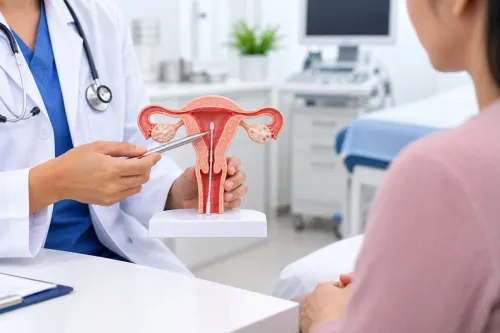

ICSI can be considered when sperm numbers, movement, or fertilisation ability make IUI unlikely to work, but it is not a standalone replacement for IUI. By comparing semen findings, female-partner factors, previous outcomes, and treatment demands, you can identify which questions to take to a fertility specialist.
Key takeaways
- IUI places washed sperm near the egg; ICSI injects one sperm directly into an egg.
- Review total motile sperm count before deciding whether IUI has a reasonable chance.
- Severe sperm abnormalities can make IVF with ICSI more suitable than IUI.
- Check age, ovarian reserve, and treatable male-infertility causes before choosing treatment.
ICSI and IUI solve different parts of the fertility problem
ICSI treatment is not a direct replacement for IUI. IUI for male infertility places laboratory-washed sperm into the uterus around ovulation, leaving sperm to reach and fertilise the egg.
ICSI is a laboratory fertilisation method within an IVF cycle: ovarian stimulation and egg retrieval come first, an embryologist injects one sperm into one retrieved egg, then embryos are cultured and transferred.
| Option | What happens | When it fits |
|---|---|---|
| IUI | Prepared sperm is placed in the uterus; no egg retrieval or laboratory fertilisation | Mild count, motility, or morphology problems when enough motile sperm remain after washing |
| IVF with ICSI | One sperm is injected into each mature retrieved egg, followed by embryo culture and transfer | Very low sperm numbers or motility, severe sperm abnormalities, previous failed fertilisation, or surgically retrieved sperm |
The practical choice is lower intensity versus greater ability to bypass sperm-transport and egg-penetration barriers. IUI depends on enough motile sperm surviving preparation and reaching the egg; IVF with ICSI adds stimulation, retrieval, laboratory work, medication, procedure-related risks, and cost.
ICSI treatment instead of IUI for male infertility makes sense when the sperm problem, previous fertilisation result, or overall fertility situation justifies IVF. ICSI does not automatically improve live-birth chances without male-factor infertility or previous fertilisation failure. Ask what specific finding supports ICSI treatment rather than treating it as a more powerful form of IUI.
What semen results show whether IUI has a reasonable chance
An IUI has a reasonable chance when processing recovers enough progressively moving sperm, not when one semen value looks acceptable. Review concentration, progressive motility, morphology, and total motile sperm count together before choosing male infertility fertility treatment.
| Measurement | What it tells you | Why it matters for IUI |
|---|---|---|
| Sperm concentration | How many sperm are present per millilitre | A low count limits the pool available for processing |
| Progressive motility | How many sperm move forward effectively | Forward-moving sperm are more likely to travel toward the egg |
| Morphology | The percentage with typical shape and structure | Very abnormal forms can reduce the number of usable sperm |
| Total motile sperm count | An estimate of moving sperm in the entire ejaculate | It shows the starting supply before laboratory preparation |
| Post-wash total motile sperm count | The motile sperm remaining after preparation | It most closely reflects the sperm actually placed in the uterus |
The AUA/ASRM guideline notes that IUI pregnancy rates are reduced when post-wash total motile sperm count is below about 5 million. Ask the clinician for your post-wash result and the clinic’s threshold; that figure often guides whether IUI or ICSI is more sensible.
Repeat an abnormal analysis because results vary between ejaculates. The guideline recommends at least two analyses, ideally at least one month apart. Interpret them with the physical examination, medical history, female-partner age, ovarian reserve, and previous treatment outcomes. A semen report alone cannot decide treatment.
When severe male-factor findings make IVF with ICSI more suitable
A post-wash total motile sperm count below about 5 million reduces IUI pregnancy rates and warrants a serious IVF-with-ICSI discussion. IUI may still suit mild count, motility, or morphology abnormalities when laboratory processing recovers enough motile sperm.
| Option | What happens | Findings that support it |
|---|---|---|
| IUI | Washed sperm is placed in the uterus around ovulation | Mild male-factor changes with an adequate post-wash count |
| IVF with ICSI | One viable sperm is injected into each mature egg after egg retrieval; embryos are then cultured and transferred | Very low total motile sperm count, severe oligozoospermia, severe asthenozoospermia, or severe teratozoospermia |
| IVF with ICSI after retrieval | Sperm obtained through TESA or TESE is injected into retrieved eggs | Obstructive azoospermia or ejaculation problems when usable sperm can be retrieved |
Previous IVF with failed or very low fertilisation also supports choosing ICSI treatment rather than repeating fertilisation without it. In obstructive azoospermia, retrieval from the epididymis or testis may provide sperm; in non-obstructive azoospermia, surgery may find no usable sperm, so ICSI is not a guarantee.
Ask whether karyotype testing, Y-chromosome microdeletion testing, and genetic counselling apply to your results. These tests concern selected men with azoospermia or severe oligozoospermia, and some Y-chromosome deletions can pass to male children conceived through ICSI.
ICSI uses one viable sperm per mature egg, but it cannot create sperm, repair sperm DNA damage, or guarantee an embryo. The right male infertility fertility treatment depends on the diagnosis, retrieval prospects, female-partner factors, and prior results—not simply on choosing iui or icsi.
Why age, ovarian reserve, and treatable causes can change the plan
Age and ovarian reserve can change the plan even when male-factor findings are moderate. ICSI cannot correct poor egg quality, low ovarian reserve, blocked or absent fallopian tubes, or a uterine condition that prevents implantation.
If repeated IUI would consume valuable time, IVF with ICSI may be preferable; normal female fertility and an adequate post-wash count can support a limited IUI course. There is no universal number of attempts: set the stopping point using age, diagnosis, ovarian response, sperm results, previous outcomes, and your tolerance for treatment.
| Option | What happens | When it fits |
|---|---|---|
| IUI for male infertility | Washed sperm is placed in the uterus around ovulation | Mild abnormalities with adequate post-wash motile sperm |
| IVF with ICSI | One sperm is injected into one retrieved egg, followed by embryo transfer | Severe sperm problems, failed fertilisation, or time-sensitive female factors |
| Other pathway | Treat the cause, retrieve sperm, or use donor sperm | IUI is unsuitable or no usable sperm is available |
- Varicocele, obstruction, endocrine disorders, medication effects, anabolic-steroid use, and ejaculatory or sexual dysfunction.
- Testosterone therapy, which suppresses sperm production and is not a fertility treatment while trying to conceive.
- Surgical retrieval with IVF/ICSI for suitable obstruction, or donor sperm and specialist care when retrieval fails.
IUI or ICSI is therefore a diagnosis-led decision, not a choice based on sperm severity alone.
What to ask before choosing ICSI treatment instead of IUI
Choosing ICSI treatment instead of IUI for male infertility requires more than one low semen result. Take these questions to your consultation:
| Option | What it involves | Ask why it applies |
|---|---|---|
| IUI | Prepared sperm placed in the uterus; no egg retrieval | Is the post-wash total motile sperm count adequate? |
| Conventional IVF | Retrieved eggs are fertilised with sperm in the laboratory | Is there a reason to avoid ICSI treatment? |
| IVF with ICSI | One sperm is injected into each mature retrieved egg | Was fertilisation previously unsuccessful or is sperm severely limited? |
- Request the dates and values from at least two semen analyses: concentration, progressive motility, morphology, total motile sperm count, and post-wash total motile sperm count.
- Ask whether TESA or TESE is being considered, and what happens if no retrievable sperm is found.
- Request the clinic’s IUI pregnancy and live-birth figures by age and diagnosis, not a general success-rate promise.
- Ask for cancellation criteria, embryo-transfer policy, and total medication, egg-retrieval, laboratory, and storage costs.
- Ask how many IUI attempts the team recommends and which result would trigger a change to IVF with ICSI.
- If azoospermia or severe oligozoospermia is present, ask about genetic counselling and karyotype or Y-chromosome microdeletion testing.
Kore Fertility Centre can help connect semen findings with ovarian reserve, tubal status, age, and previous outcomes to build a male infertility fertility treatment plan rather than recommend ICSI automatically.
Related services
Intrauterine Insemination (IUI) Intrauterine Insemination (IUI) Intrauterine Insemination (IUI) at Kore Fertility Centre is a commonly recommended fertility treatment that improves the chances of conception by... View service → |
Testicular Sperm Extraction (TESE) Testicular Sperm Extraction (TESE) Testicular Sperm Extraction (TESE) at Kore Fertility Centre is a minor surgical procedure used to retrieve sperm directly from the testicular tissue... View service → |
Frequently asked questions
Is ICSI treatment a direct replacement for IUI for male infertility?
No. IUI places washed sperm in the uterus and relies on natural fertilisation, while ICSI injects a selected sperm into an egg during IVF.
Which semen results help assess whether IUI has a reasonable chance?
Ask your fertility specialist to review sperm concentration, motility, morphology, and the total motile sperm count after laboratory preparation.
When is IVF with ICSI more suitable than IUI?
IVF with ICSI becomes more suitable when sperm numbers or movement are severely reduced, sperm cannot reach the egg reliably, or previous IUI attempts have not worked.
Can age and ovarian reserve change the choice between IUI and ICSI?
Yes. Female age, antral follicle count, anti-Müllerian hormone results, ovulation, and the time available for treatment can change the recommended plan.
What should you ask before choosing ICSI instead of IUI?
Ask which semen findings drive the recommendation, whether a treatable cause exists, how many cycles are reasonable, what each treatment involves, and how success will be assessed.
Related services
In Vitro Fertilization (IVF) In Vitro Fertilization (IVF) at Kore Fertility Centre is an advanced fertility treatment designed to help couples overcome infertility and achieve a... View service → |
Testicular Sperm Aspiration (TESA) Testicular Sperm Aspiration (TESA) Testicular Sperm Aspiration (TESA) at Kore Fertility Centre is a minimally invasive sperm retrieval procedure used to collect sperm directly from the... View service → |
Keywords