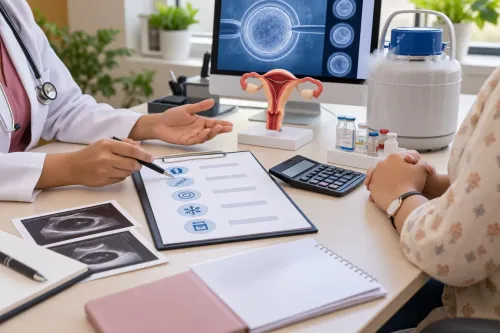
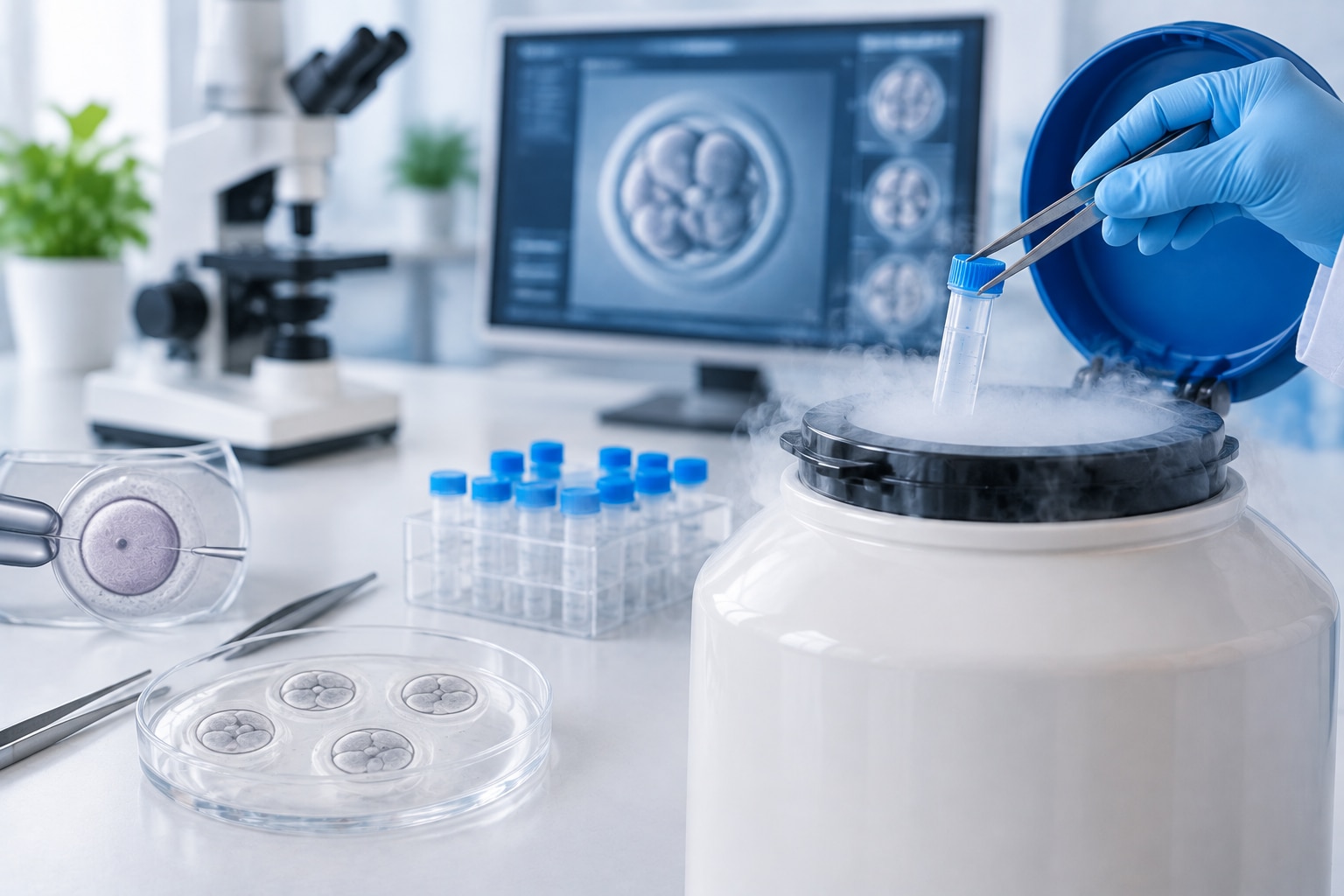
Choosing what to freeze depends on your treatment stage, age, medical plans, laboratory results, and who will hold future decision-making rights. By the end, you will understand how specialists select eggs or embryos, how vitrification and storage work, and what happens when material is warmed for treatment.
Key takeaways
- Age at retrieval predicts egg competence more than AMH or antral-follicle count.
- Freeze eggs when sperm or a partner is unavailable; freeze embryos when fertilisation is planned.
- Embryos are graded after development, then vitrified and stored in liquid nitrogen.
- Ask why a freeze-all cycle or genetic testing is recommended before consenting.
How specialists decide whether to freeze eggs, embryos, sperm, or tissue
A cryopreservation consultation separates two questions: how many eggs or embryos you can store, and how likely they are to produce a live birth. Age at egg retrieval is a major predictor of egg competence. AMH and antral-follicle count estimate ovarian response and expected egg yield; they do not measure egg quality.
Retrieved eggs can be immature, fail to fertilise, stop developing, or fail to survive warming, so ask for results at each stage rather than one headline number.
Fertility specialists’ cryopreservation decisions commonly follow these circumstances:
- Unfertilised eggs: useful when you want reproductive-use decisions to remain with you, or a sperm source or partner is not yet settled.
- Embryos: useful when sperm is available and you accept shared genetic-contributor consent and future-use rules.
- Sperm: useful before chemotherapy, gonadotoxic treatment, surgery, or a procedure that could reduce sperm production.
- Ovarian, testicular, or other reproductive tissue: considered when treatment cannot wait for egg or sperm collection, including some childhood cancer cases.
Embryo storage requires signed decisions about use after treatment ends, separation or relationship changes, withdrawal of consent where local law permits, disposal or donation, and unpaid storage fees. Egg storage usually leaves reproductive-use decisions with the egg provider, subject to local law and signed clinic forms.
Ask exactly what happens when consent changes or an account becomes overdue.
What happens during the egg freezing process
The egg freezing process begins with injectable gonadotropins that stimulate several follicles instead of one. Monitoring uses transvaginal ultrasound and blood tests to track follicle growth and hormone levels.
- A trigger injection completes final egg maturation when the follicles are ready.
- About 34–36 hours later, clinicians retrieve the eggs through the vagina with an ultrasound-guided needle under sedation or anaesthesia.
- Embryologists assess maturity. Metaphase-II (MII) eggs are the standard candidates for routine vitrification; immature eggs may need additional laboratory handling or may not be usable.
- Each stored egg receives an identifier, while inventory records document its location in a labelled storage tank.
Vitrification has largely replaced slow freezing for mature oocytes because it cools them ultra-rapidly and reduces ice-crystal formation. Slow freezing lowers temperature more gradually, which increased the risk of damaging crystals and produced poorer outcomes with mature eggs.
| Method | Cooling approach | Practical result |
|---|---|---|
| Vitrification | Ultra-rapid cooling | Less ice-crystal formation; standard for mature eggs |
| Slow freezing | Gradual cooling | Older method, largely replaced for mature eggs |
Storage pauses age-related decline in the eggs collected at that time; it does not preserve fertility indefinitely. Success still depends on collection age, the number of mature eggs, warming survival, fertilisation, and later uterine factors.
An egg is never placed directly into the uterus. During treatment, the laboratory warms it, usually fertilises it with ICSI, cultures the resulting embryo, and later transfers or refreezes that embryo. This is the laboratory pathway used in fertility specialists’ egg and embryo cryopreservation care.
How embryos are created, graded, and prepared for freezing
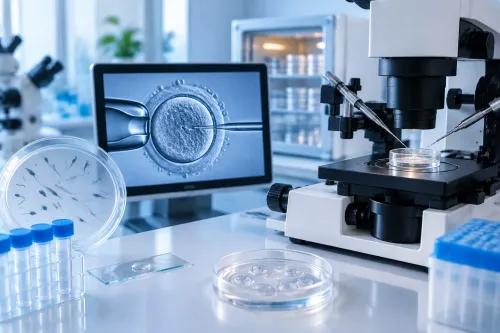
Eggs are fertilised through conventional IVF, where sperm and egg meet in a laboratory dish, or ICSI, where one sperm is injected into each egg. Embryologists culture the resulting embryos and record cell division, symmetry, fragmentation, and ongoing development.
This embryo freezing care has separate attrition points: retrieved eggs become mature eggs, mature eggs may fertilise, fertilised eggs may keep developing, and only some become transferable embryos.
| Stage | What is assessed | Main trade-off |
|---|---|---|
| Cleavage stage | About day 2 or 3; cell number, symmetry, and fragmentation | Freezes earlier, before extended culture filters embryos |
| Blastocyst stage | About day 5 to 7; expansion, inner-cell mass, and trophectoderm appearance | Stronger selection among embryos that continue developing, but some potentially usable embryos stop before blastocyst |
An embryo grade describes its appearance at that moment, not its destiny. A high grade does not guarantee implantation or a live birth, and a lower grade is not automatically unusable. Fertility specialists egg and embryo cryopreservation decisions therefore consider embryo development, the number available, treatment history, and your transfer plan.
When extra embryos exist, specialists weigh earlier freezing against extended culture. They freeze suitable embryos at the agreed stage using vitrification, while recording identification and storage details.
Ask for results reported separately for retrieved eggs, mature eggs, fertilisation, ongoing development, transferable embryos, and warming survival; combining these figures can make the expected outcome look better than it is.
What happens when a frozen egg or embryo is warmed for transfer
After warming, the laboratory assesses whether each egg or embryo has survived before treatment continues. This controlled process does not guarantee viability: some cells may not recover their shape or function.
A warmed egg is usually fertilised with intracytoplasmic sperm injection (ICSI), because freezing can alter its outer layer and make conventional sperm penetration unreliable. The resulting embryo is cultured, then transferred or frozen again if it reaches a suitable stage.
For an embryo, the team selects a surviving embryo appropriate for transfer and prepares the endometrium to receive it. Good embryo freezing care includes accurate identification, warming records, and stage-specific survival reporting.
For fertility specialists, cryopreservation also changes the timing of transfer:
| Transfer type | Timing | Endometrium preparation |
|---|---|---|
| Fresh embryo transfer | Same ovarian-stimulation cycle | Lining develops during stimulation |
| Frozen embryo transfer | Later, after warming | Natural or modified-natural ovulation, or estrogen followed by progesterone |
A natural or modified-natural cycle suits you when ovulation is reliable. If it is not, hormonal preparation builds the lining with estrogen before progesterone begins; progesterone exposure must match embryo age, especially for a blastocyst.
A clinic may choose frozen transfer after high progesterone, an unsuitable lining, elevated ovarian hyperstimulation syndrome risk, or genetic testing. The trade-off is an added delay, warming step, cost, and the possibility that no embryo remains available after testing or warming.
A freeze-all plan is therefore useful in selected cases, not automatically better than fresh transfer.
When specialists use freeze-all cycles, genetic testing, and risk controls
Extra embryos that are suitable for storage are frozen after the planned transfer, or all embryos are frozen when a fresh transfer could increase risk or reduce timing. A transfer is cancelled for high OHSS risk, rising progesterone, an unsuitable endometrium, or genetic testing.
| Pathway | Why it is chosen | What changes |
|---|---|---|
| Fresh transfer | No major safety or timing concern | Transfer occurs in the stimulation cycle |
| Freeze-all | OHSS risk, high progesterone, or poor lining | Adds delay, warming, cost, and possible loss before transfer |
| PGT cycle | Embryos need chromosome testing | Biopsy and vitrification precede a later transfer |
PGT usually requires culture to day 5–7, a small blastocyst biopsy, and vitrification while results are pending. PGT-A can identify abnormal chromosome numbers; it cannot guarantee implantation or a healthy child, and routine PGT-A is not automatically beneficial for every IVF patient. Some embryos also fail to reach blastocyst or survive warming.
OHSS is the main acute stimulation concern, with higher risk in polycystic ovary syndrome or high ovarian reserve. Specialists reduce it with personalised gonadotropin doses, antagonist protocols, an agonist trigger when appropriate, and sometimes freeze-all treatment.
- Maturity, fertilisation, blastocyst, warming-survival, and transfer outcomes reported by stage.
- Storage duration, fees, renewal terms, and consent rules after treatment ends or circumstances change.
- How fertility specialists handle cryopreservation decisions for your findings and plans.
Kore Fertility Centre can help patients in Zirakpur compare that proposed pathway with their medical findings and future plans.
Related services
Cryopreservation Cryopreservation at Kore Fertility Centre is an advanced fertility preservation service that allows the safe freezing and storage of sperm, eggs, embryos, or... |
Donor Programme The Donor Programme at Kore Fertility Centre offers advanced assisted reproductive solutions for individuals and couples who require donor eggs,... View service → |
Frequently asked questions
How do fertility specialists decide whether to freeze eggs, embryos, sperm, or tissue?
They consider age, ovarian reserve, sperm availability, relationship and treatment plans, cancer treatment timing, and whether reproductive tissue can be safely collected. Age at egg retrieval helps predict egg competence, while AMH and antral-follicle count estimate ovarian response and egg yield rather than egg quality.
What happens during the egg freezing process?
The process includes ovarian stimulation, ultrasound and hormone monitoring, a trigger injection, egg retrieval, assessment of mature eggs, vitrification, and storage in liquid nitrogen. The clinic also records the number of mature eggs and the storage identification details.
How are embryos created, graded, and prepared for freezing?
Retrieved eggs are fertilised with sperm, usually through conventional insemination or intracytoplasmic sperm injection. Embryologists monitor development, grade embryos using their cell structure and expansion, then vitrify suitable embryos and store them in labelled cryogenic containers.
What happens when a frozen egg or embryo is warmed for transfer?
The laboratory warms the egg or embryo and checks whether it has survived the process. A warmed embryo can then be transferred during a prepared or natural-cycle uterus. A warmed egg must be fertilised before embryo culture and transfer.
When do specialists use freeze-all cycles, genetic testing, and risk controls?
A freeze-all cycle stores embryos instead of transferring them in the retrieval cycle when the uterine lining, hormone levels, ovarian hyperstimulation risk, or timing makes later transfer safer. Genetic testing is considered for specific clinical indications, and risk controls include monitoring, trigger selection, careful lab identification, and verified storage procedures.
Related services
In Vitro Fertilization (IVF) In Vitro Fertilization (IVF) at Kore Fertility Centre is an advanced fertility treatment designed to help couples overcome infertility and achieve a... View service → |
Testicular Sperm Extraction (TESE) Testicular Sperm Extraction (TESE) Testicular Sperm Extraction (TESE) at Kore Fertility Centre is a minor surgical procedure used to retrieve sperm directly from the testicular tissue... View service → |
Ultrasonography Ultrasonography at Kore Fertility Centre is a safe, non-invasive diagnostic imaging service used to evaluate reproductive health, monitor pregnancy, and assist in... |
Testicular Sperm Aspiration (TESA) Testicular Sperm Aspiration (TESA) Testicular Sperm Aspiration (TESA) at Kore Fertility Centre is a minimally invasive sperm retrieval procedure used to collect sperm directly from the... View service → |
Keywords