
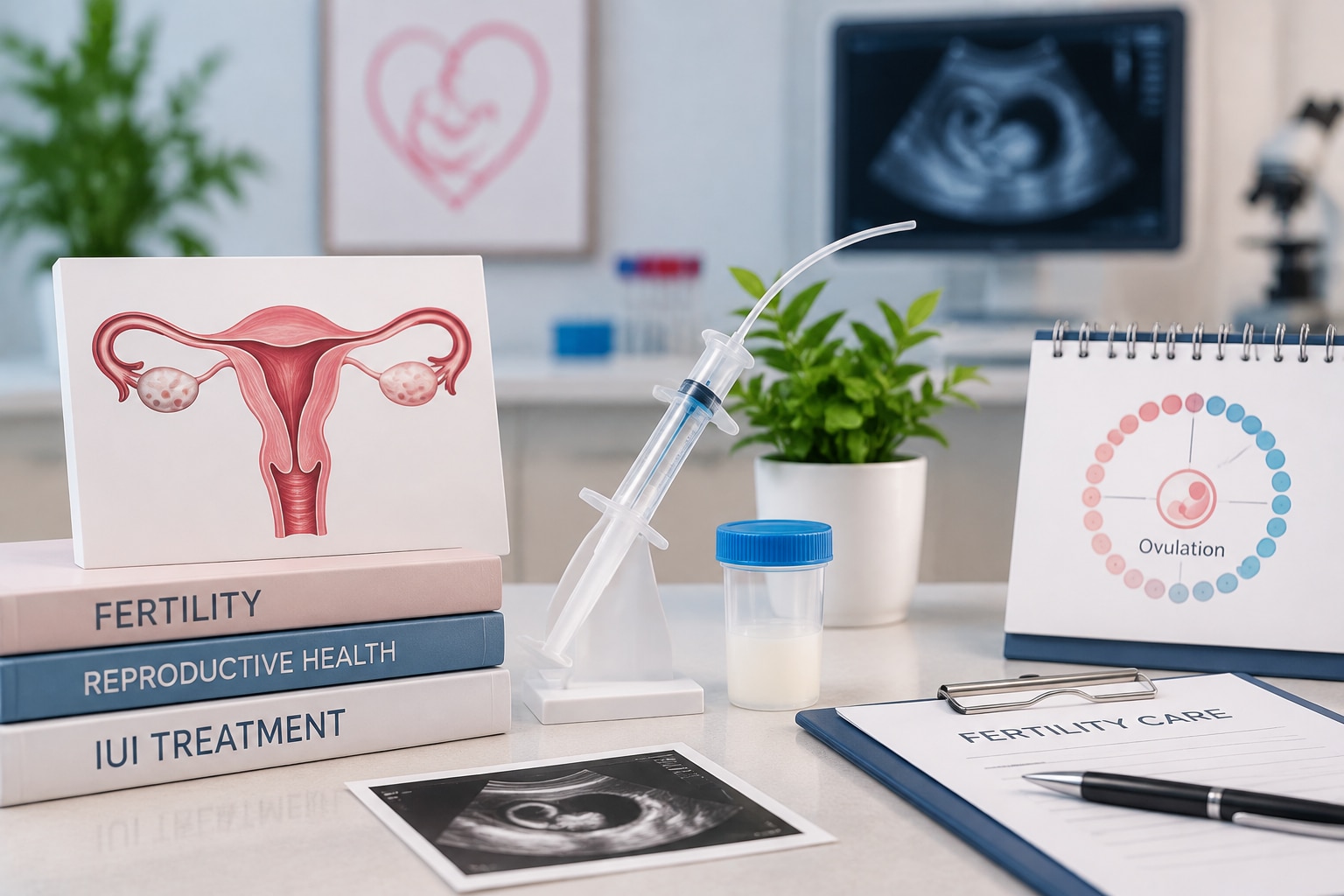
A negative pregnancy test after IUI does not automatically show that the procedure failed or was performed incorrectly, but repeated problems deserve a structured review. You will be able to identify which cycle findings require investigation, what records to request, and when repeating IUI is less sensible than changing the treatment plan.
Key takeaways
- Request a review after repeated negative tests or a cycle-monitoring problem.
- Check medication timing, ovulation confirmation, follicle growth, and insemination details.
- Ask whether sperm quality, blocked tubes, uterine findings, or ovarian reserve limit IUI.
- Take cycle records, medication details, test results, and semen reports to your consultation.
Which IUI treatment problems justify a clinic review?
A clinic review is justified when an IUI cycle reveals a correctable problem or when several appropriately monitored cycles end in negative pregnancy tests. One unsuccessful cycle does not prove IUI is not working; many patients need more than one attempt.
The review should consider completed cycles, age, infertility diagnosis, ovarian reserve, semen results, follicular response and treatment duration.
- No ovulation, poor follicle growth or a thin endometrium.
- Premature ovulation before insemination, or insemination performed too early or too late.
- A cancelled cycle, including cancellation after too many mature follicles develop.
- An absent, missed or poorly timed hCG trigger.
- An inadequate post-wash total motile sperm count, particularly below about 5 million.
- Repeated negative pregnancy tests after monitored cycles.
| Finding | What it means | When it applies |
|---|---|---|
| One negative test | A single failure is common and does not prove a process error | Review the cycle data before repeating |
| Three or four oral-stimulation cycles without pregnancy | The diagnosis, protocol or treatment choice needs reassessment | Set a stopping point for unexplained infertility rather than repeating unmedicated IUI indefinitely |
| Higher-risk circumstances | IVF may deserve earlier discussion | Age 38 or older, reduced ovarian reserve, severe endometriosis, tubal disease or significant male-factor infertility |
Ask the clinic to review ultrasound follicle sizes, endometrial thickness, ovulation confirmation, trigger timing and pre- and post-wash semen results. A defined plan should state how many further cycles are reasonable and what finding would prompt IVF or another pathway.
What cycle, medication, and monitoring errors can reduce IUI success?
A technically completed IUI can still have a poor chance of success if the ovary, uterine lining, or timing was unsuitable. An IUI treatment review should separate treatment failure from IUI treatment problems caused by missed medication, inadequate monitoring, or incorrect timing.
1. Check the stimulation plan. Confirm whether any letrozole or clomiphene doses were missed, whether the dose produced inadequate follicular growth or an excessive response, and whether an ovarian cyst was present before stimulation. PCOS can produce either under-response or over-response, so increasing the dose without reviewing the pattern is unsafe.
2. Reconstruct the monitoring record. Document each follicle’s count and size, endometrial thickness, fluid in the pelvis, and whether ovulation was confirmed when clinically indicated. The record should show the urinary or serum LH result and explain whether the response met the clinic’s threshold for proceeding.
3. Audit the timing. Verify the hCG trigger dose, injection time, actual ovulation timing, and insemination time. An absent or incorrectly timed trigger, premature ovulation, or an IUI performed too early or too late can reduce the chance of fertilisation. Failure to cancel after premature ovulation is also a process concern.
A cycle may need cancellation when too many mature follicles develop because multiple pregnancy is the main avoidable risk of stimulated IUI. Ask which follicle threshold the clinic uses and why it selected natural-cycle IUI, oral medication, or closer monitoring for your next cycle.
Which sperm, tube, uterus, and ovarian findings make IUI a poor fit?
A post-wash total motile sperm count below about 5 million warrants an IUI treatment review, not an automatic declaration of permanent male infertility. Request the pre-wash and post-wash counts, progressive motility, semen volume, collection details, and time from ejaculation to laboratory processing.
Repeat semen analysis and assessment by a male-reproductive urologist can identify varicocele, medication effects, endocrine disease, or ejaculatory problems.
If your search was “iui for treatment fertility clinic problems,” check the female prerequisites too: at least one open fallopian tube, ovulation, and a usable uterine cavity. Review prior pelvic infection, ectopic pregnancy, endometriosis, tubal surgery, diminished ovarian reserve, uterine polyps, cavity-distorting fibroids, and cervical factors.
Ask the clinic which finding applies:
- A blocked tube prevents IUI from bypassing the problem; bilateral blockage makes IVF or another pathway more suitable.
- A low ovarian reserve does not automatically rule out IUI, but it reduces the time available for repeated cycles.
- A uterine cavity lesion can prevent implantation even when ovulation and sperm processing are adequate.
| Test | What it assesses | Main limitation or use |
|---|---|---|
| Hysterosalpingography or HyCoSy | Fallopian-tube patency | Select according to history and local expertise |
| Saline infusion sonography | Polyps, fibroids, and cavity shape | Does not assess sperm or ovulation |
| Hysteroscopy | Diagnoses and treats intracavity lesions | Invasive procedure |
| Laparoscopy | Selected endometriosis or pelvic disease | Reserve for specific clinical suspicion |
Each test has limits, so investigate the history rather than repeat IUI by default.
What should you take to a fertility clinic IUI consultation?
Bring a complete cycle record to a fertility clinic IUI consultation. Without it, “IUI is not working” cannot be separated from a poor prognosis, a monitoring problem, or a mistimed cycle.
1. Record each cycle date, medication name and dose, missed letrozole or clomiphene doses, ultrasound reports, follicle measurements, endometrial thickness, ovarian cyst findings, LH results, trigger name and injection time, insemination time, luteal-support instructions, and pregnancy-test dates.
2. Ask how many cycles were actually completed, whether ovulation was confirmed, and whether any cycle was cancelled or continued despite an excessive or inadequate response.
3. Ask for every semen report, including pre-wash and post-wash sperm counts, progressive motility, semen volume, and processing time. A low post-wash count needs interpretation and a plan, not an automatic repeat.
4. Confirm whether at least one fallopian tube is patent and ask whether the uterine cavity needs investigation for a polyp, fibroid, adhesion, or other abnormality.
5. Ask for the maximum number of further IUI cycles and the result that would change that plan. Do not accept indefinite repetition without a stopping point.
Kore Fertility Centre can use this documented IUI treatment review to decide whether to repeat IUI, alter stimulation, use a natural cycle, investigate a male or female factor, consider donor sperm, move to IVF, or pause treatment. The useful outcome is a reasoned next step, not simply another prescription.
Related services
Intrauterine Insemination (IUI) Intrauterine Insemination (IUI) Intrauterine Insemination (IUI) at Kore Fertility Centre is a commonly recommended fertility treatment that improves the chances of conception by... View service → |
In Vitro Fertilization (IVF) In Vitro Fertilization (IVF) at Kore Fertility Centre is an advanced fertility treatment designed to help couples overcome infertility and achieve a... View service → |
When should you stop repeating IUI or seek urgent medical care?
Severe or one-sided pelvic pain, fainting, shoulder-tip pain, heavy bleeding, fever, or shortness of breath needs prompt medical assessment, not a routine fertility clinic IUI consultation. These symptoms can signal ectopic pregnancy, infection, ovarian torsion, or ovarian hyperstimulation.
Reconsider repeating IUI when three or four oral-stimulation cycles have failed, ovarian-reserve markers are worsening, age is reducing your available time, semen findings remain severely limiting, both tubes are blocked, or severe endometriosis or a cavity abnormality remains untreated.
“IUI not working” does not mean one negative test proves failure; it means the treatment plan deserves reassessment after appropriately monitored cycles. Compare the following before authorising another attempt:
| Option | Time and effort | Main risks or burdens |
|---|---|---|
| Further IUI | More monitoring and waiting | Cancellation, multiple pregnancy, emotional strain, repeated cost |
| IVF | Greater treatment intensity but fewer repeated insemination cycles | Higher cost, medication burden, ovarian hyperstimulation |
| Another specialist pathway or no treatment | Time may shift to diagnosis, preservation, or a deliberate pause | Delayed pregnancy, uncertainty, or emotional relief |
A home pregnancy test taken too early can give a misleading negative result. Use the clinic’s specified test date, then report bleeding or pain instead of assuming the cycle is final.
During review, ask what result will end IUI, whether IVF or another specialist is more suitable, and how cost, monitoring, pregnancy risk, and your preferences change that decision.
Frequently asked questions
Which IUI treatment problems justify a clinic review?
Request a review after a medication or timing error, inadequate monitoring, an unexpected cycle result, or several properly monitored cycles with negative pregnancy tests.
What cycle, medication, and monitoring errors can reduce IUI success?
Problems include incorrect medication timing or dose, missed monitoring scans, failure to confirm ovulation, poorly timed insemination, and incomplete documentation of follicle growth and the uterine lining.
Which sperm, tube, uterus, and ovarian findings make IUI a poor fit?
IUI may be a poor fit with blocked fallopian tubes, severe sperm abnormalities, significant uterine disease, markedly reduced ovarian reserve, or an ovarian response that cannot be safely controlled.
What should you take to a fertility clinic IUI consultation?
Take ultrasound reports, hormone results, semen analyses, tubal testing, prior treatment notes, medication names and doses, cycle dates, pregnancy-test results, and a list of questions.
When should you stop repeating IUI or seek urgent medical care?
Discuss changing treatment after repeated unsuccessful, well-monitored cycles or when testing identifies a low chance of IUI success. Seek urgent care for severe pain, heavy bleeding, fainting, breathing difficulty, or symptoms after stimulation that could indicate ovarian hyperstimulation.
Related service
Fertility Checkup at Kore Fertility Centre is a comprehensive evaluation designed to assess the reproductive health of both men and women. View service → |
Keywords