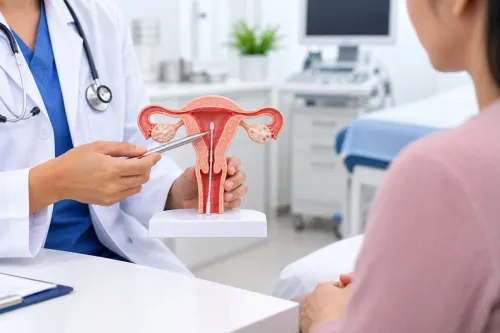

Two pregnancy losses now justify a recurrent pregnancy loss assessment in many current guidelines, while some clinics still wait for three. The right test tube baby centre will investigate the cause before recommending IVF, explain which treatment fits the findings, and separate evidence-based care from expensive add-ons.
Key takeaways
- Begin recurrent pregnancy loss assessment after two pregnancy losses.
- Request evaluation before accepting IVF as the first treatment.
- Choose natural conception when testing finds a treatable or no clear cause.
- Compare IVF treatment options, embryo testing limits, and follow-up care.
When should recurrent pregnancy loss assessment begin?
Two pregnancy losses are enough to justify a recurrent pregnancy loss assessment. ASRM and ESHRE use two or more failed pregnancies in current definitions, although some clinicians and older protocols still require three consecutive losses. Waiting for a third loss can delay evaluation without adding useful information.
The timing and gestational age of each loss shape the investigation. Record whether each pregnancy ended before or after ultrasound confirmation, at what week bleeding or fetal loss occurred, and whether a heartbeat had been seen.
Very early biochemical losses raise different questions from losses after a confirmed heartbeat; second-trimester losses or stillbirths increase concern about cervical, uterine, placental, genetic, or antiphospholipid-related causes.
Begin recurrent pregnancy loss fertility care after the second documented loss, while reviewing the full pregnancy history rather than counting events mechanically. A test tube baby centre for recurrent pregnancy loss should assess potentially treatable causes before recommending IVF. That includes checking the uterine cavity and discussing targeted blood, genetic, and pregnancy-tissue testing when indicated.
IVF does not replace this work-up, and unexplained losses do not automatically make embryo transfer the right next step.
What should a centre investigate before recommending IVF?
A test tube baby centre should complete a cause-focused work-up before recommending IVF, especially after two losses rather than insisting on three. Ask for written results, the reason for each test, and the treatment decision it could change.
1. Assess the uterine cavity with three-dimensional transvaginal ultrasound. Saline infusion sonography, hysteroscopy, or MRI may follow a specific finding. A septum, polyp, fibroid, or adhesions may need treatment before embryo transfer.
2. Test for antiphospholipid antibodies: lupus anticoagulant, anticardiolipin antibodies, and anti-β2-glycoprotein I antibodies. A single positive result is not enough; confirmatory testing must follow the required interval before diagnosing antiphospholipid syndrome.
3. Check thyroid-stimulating hormone and screen for diabetes with HbA1c or fasting glucose. The centre should separate thyroid disease needing treatment from thyroid-peroxidase antibody positivity alone, rather than selling levothyroxine as a blanket IVF add-on.
4. Offer parental karyotypes to identify a balanced chromosome rearrangement that could affect embryos.
5. If tissue from a prior loss is available, discuss products-of-conception testing, usually chromosomal microarray. The result can guide genetic counselling and future treatment.
6. Measure ovarian reserve with antral follicle count, anti-Müllerian hormone, and, when indicated, day-2 to day-4 FSH. These tests estimate response to stimulation; they do not diagnose the cause of miscarriage.
7. Evaluate semen with a standard semen analysis. Sperm DNA-fragmentation testing belongs in selected cases, not every first-line package; ask how an abnormal result would change management.
A clinic offering genuine recurrent pregnancy loss fertility care explains these findings before presenting IVF options.
When is natural conception better than IVF after recurrent miscarriage?
Natural conception is usually better after recurrent miscarriage when you can identify and treat a non-embryo cause, and there is no separate infertility problem. IVF after recurrent miscarriage adds ovarian stimulation, egg retrieval, embryo biopsy and transfer; it does not repair every reason a pregnancy ends.
| Cause | What IVF can do | When monitored natural conception is preferable |
|---|---|---|
| Uterine disease | IVF cannot correct a septum, polyp, fibroid or adhesions | Treat the cavity problem before trying again |
| Antiphospholipid syndrome | IVF does not remove the clotting risk | Use specialist-directed treatment and pregnancy monitoring |
| Parental chromosome rearrangement | PGT-SR can reduce transfer of embryos with an unbalanced rearrangement | Try naturally with prenatal diagnosis, if acceptable |
| Embryo aneuploidy | PGT-A can identify some embryos with abnormal chromosome numbers | Consider it only after discussing age, embryo numbers, laboratory limits and alternatives |
| Unexplained loss | No IVF treatment has proved superior to natural conception | Try naturally when fertility is otherwise satisfactory |
A balanced parental rearrangement does not make IVF compulsory. Natural conception with chorionic-villus sampling or amniocentesis, donor gametes and adoption are separate choices. PGT-SR lowers the chance of transferring a known unbalanced embryo but does not guarantee a live birth.
Similarly, one miscarriage with an abnormal chromosome result does not prove that you need IVF or PGT-A. The result can reflect a sporadic event, and testing can fail through insufficient tissue or maternal-cell contamination. Ask for genetic counselling before choosing among ivf treatment options.
Natural conception becomes less attractive when age-related infertility, blocked tubes, severe male-factor infertility or repeated aneuploid losses changes the expected chance of success. In that situation, compare IVF options with targeted treatment rather than treating IVF as the diagnosis.
How do IVF treatment options differ for recurrent pregnancy loss?
The right IVF treatment options depend on the suspected cause; IVF after recurrent miscarriage is not a standard package.
| Option | What it does | When it fits |
|---|---|---|
| Conventional IVF | Fertilises eggs with sperm in the laboratory | Infertility exists without a specific sperm-injection indication |
| ICSI | Injects one sperm into each mature egg | Severe male-factor infertility or previous fertilisation failure |
| Frozen embryo transfer | Transfers an embryo in a later, prepared cycle | After biopsy, ovarian stimulation, or when endometrial timing needs control |
| Single-embryo transfer | Transfers one embryo, reducing multiple-pregnancy risk | When a suitable embryo is available; it does not remove miscarriage risk |
| Donor eggs | Uses eggs from a screened donor | Marked ovarian failure, age-related embryo factors, or repeated poor egg-related outcomes |
| Donor embryos | Uses an embryo created from donor egg and sperm | When using both partners’ gametes is unsuitable or unsuccessful |
| PGT-A | Screens embryo chromosome number | Selected cases where aneuploidy is a concern; it is not a universal RPL treatment |
| PGD or PGT-M | Tests for a known single-gene disorder | When a parent carries, or the family history shows, that specific mutation |
A parental chromosome rearrangement calls for discussion of PGT-SR, natural conception with prenatal diagnosis, or donor gametes—not automatically PGT-A. Ask a test tube baby centre to explain which result changes management, how many embryos are expected, and what happens after an inconclusive or mosaic result.
Kore Fertility Centre should be assessed on this diagnosis-to-treatment reasoning, not on whether it sells a bundled IVF package.
Related services
Recurrent Pregnancy Loss Treatment Recurrent Pregnancy Loss Treatment at Kore Fertility Centre is designed to diagnose and manage the underlying causes of repeated miscarriages. View service → |
Preimplantation Genetic Testing (PGT) Preimplantation Genetic Testing (PGT) Preimplantation Genetic Testing (PGT) at Kore Fertility Centre is an advanced diagnostic procedure performed during an IVF cycle to evaluate the... View service → |
What can testing predict, and what care still matters afterward?
A PGT result predicts only what the tested cells can reveal. PGT-A can identify some embryo chromosome-number abnormalities, but it does not test every cause of miscarriage or guarantee a live birth. Biopsy samples can produce an inconclusive result, and mosaic embryos can be misclassified or wrongly excluded.
Prenatal testing, including screening or diagnostic testing, may still be discussed after pregnancy begins.
In recurrent pregnancy loss fertility care, ask how the following findings would change treatment:
- Repeat antiphospholipid antibody testing when the first result is positive or borderline; confirmed antiphospholipid syndrome is needed before recommending low-dose aspirin plus prophylactic heparin.
- Do not accept aspirin or heparin as routine treatment for unexplained loss. Heparin adds injections and bleeding risk without the same proven benefit when antiphospholipid syndrome is absent.
- Treat immune add-ons, such as intralipids or intravenous immunoglobulin, as unproven rather than standard care.
- Treat sperm DNA-fragmentation testing as optional and its treatment implications as uncertain; a high result does not identify a single established cause of miscarriage.
Choosing IVF after recurrent miscarriage does not remove uncertainty, especially when testing finds no cause. Early-pregnancy care still matters: arrange prompt clinical review, serial hormone assessment when indicated, and ultrasound monitoring. Age, previous outcomes, and supportive follow-up can influence the chance of a live birth even without IVF.
Frequently asked questions
When should recurrent pregnancy loss assessment begin?
Assessment can begin after two pregnancy losses. Waiting for a third loss can delay investigation and treatment planning.
What should a centre investigate before recommending IVF?
Ask the centre to review pregnancy history and investigate uterine anatomy, antiphospholipid syndrome, thyroid function, diabetes risk, genetic factors, and other findings relevant to your case.
When is natural conception better than IVF after recurrent miscarriage?
Natural conception can be preferable when a treatable cause is found, ovarian reserve is adequate, and IVF would not address the reason for miscarriage.
How do IVF treatment options differ for recurrent pregnancy loss?
Options differ in ovarian stimulation, embryo culture, genetic testing, fresh or frozen transfer, and the reasons for recommending each approach.
What can testing predict, and what care still matters afterward?
Testing can identify some causes and guide treatment, but it cannot guarantee a live birth. Follow-up remains important through early pregnancy and antenatal care.
Related services
Bad Obstetric History (BOH) Treatment Bad Obstetric History (BOH) Treatment at Kore Fertility Centre is a comprehensive evaluation and treatment service for women with a history of recurrent miscarriages, stillbirths, preterm... View service → |
Preimplantation Genetic Diagnosis (PGD) Preimplantation Genetic Diagnosis (PGD) Preimplantation Genetic Diagnosis (PGD) at Kore Fertility Centre is an advanced genetic testing procedure performed during an IVF cycle to identify... View service → |
Cervical Cerclage at Kore Fertility Centre is a specialized procedure performed to help prevent premature birth and pregnancy loss caused by cervical insufficiency. View service → |
Antenatal Care at Kore Fertility Centre provides comprehensive medical care and monitoring throughout pregnancy to support the health of both mother and baby. View service → |
Keywords