The right preservation choice depends on whose reproductive material is available, how quickly treatment must begin, and how much control you want over future family-building decisions. By the end, you will know which questions, tests, records, and practical trade-offs to take to a fertility preservation consultation.
Key takeaways
- Choose preservation material based on diagnosis, treatment deadline, and future family plans.
- Embryos offer more certainty about fertilisation; eggs preserve more future partner flexibility.
- Ask whether ejaculated sperm, testicular sperm, or testicular tissue fits your diagnosis.
- Bring treatment dates, test results, and partner or donor-sperm details to the consultation.
Start with the decision that determines every preservation option
Match the material you can preserve to your diagnosis, treatment deadline, and future family plans. For cryopreservation options, an infertility specialist doctor will assess ovarian reserve, sperm production, age, cancer-treatment urgency, and whether partner or donor sperm is available.
| Option | Best fit | Decision that remains |
|---|---|---|
| Egg freezing | You produce eggs but do not want to choose sperm or create embryos now; treatment or declining ovarian reserve makes timing important | You retain control over sperm source and future relationships |
| Embryo freezing | You have partner or donor sperm and are ready to create embryos, including after IVF | You must plan for embryo storage, use, donation, or disposal |
| Ejaculated sperm | You can collect usable sperm before vasectomy, gonadotoxic treatment, or gender-affirming treatment | Future use usually involves IVF or ICSI, depending on sperm quality |
| Testicular sperm or tissue | Ejaculation is impossible, sperm production is extremely low, or urgent treatment leaves no time for repeated collection | Retrieval surgery and tissue-specific risks need review |
| Ovarian tissue | You cannot complete stimulation and egg retrieval before treatment, including in some children or urgent cancer cases | Later transplantation involves surgery and assessment of disease-cell risk |
Egg freezing commonly takes about two weeks for stimulation and transvaginal retrieval; random-start stimulation can shorten menstrual-cycle waiting. Tissue preservation is specialized, not a backup with guaranteed pregnancy. Freezing gametes does not remove age-related pregnancy risks or guarantee a live birth, and future treatment may require IVF or ICSI.
Combining routes can make sense: freeze eggs and sperm separately, create embryos when appropriate, or add tissue preservation when standard collection is impossible. Ask the infertility specialist doctor which option protects your reproductive choices without delaying essential treatment.
Eggs or embryos: which gives you more control later?
Your sperm source determines how much control you keep. Cryopreservation for eggs lets you store unfertilised eggs without choosing a partner or donor sperm now. Embryo freezing requires sperm from a partner or donor before fertilisation, so it answers more of the family-building question today.
| Option | Sperm requirement | Control later | Relationship and donor implications | Age-related outcomes |
|---|---|---|---|---|
| Eggs | None at freezing; sperm is needed for later IVF or ICSI | You choose the sperm source and whether to create embryos later | A breakup does not create a dispute over jointly created embryos; donor sperm remains an option | Egg age at freezing influences egg potential, but pregnancy risks still reflect your age at pregnancy |
| Embryos | Partner or donor sperm is required before freezing | You have embryos ready for transfer, but use depends on consent and disposition agreements | A partner’s consent, changed relationship, or donor terms can affect future use; embryo donation may require separate decisions | Embryos reflect egg and sperm ages at creation; selected genetic testing and development assessment can provide additional information |
Vitrification is used for mature eggs and embryos and reduces ice-crystal damage, but it does not guarantee warming survival or a live birth. Embryos have the longer clinical track record and can be assessed before transfer, while eggs preserve more reproductive autonomy.
Neither option removes age-related pregnancy or uterine risks, and both require later IVF or ICSI. Ask how many eggs or embryos your age and test results make reasonable to store.
Ejaculated sperm, testicular sperm, or testicular tissue?
If you can produce a usable semen sample, ejaculated sperm is usually the simplest route for cryopreservation for sperm. Your clinic can analyze concentration, movement, and shape, then freeze several labelled portions; repeated collections may help because results vary between samples.
| Option | What it means | When it applies |
|---|---|---|
| Ejaculated sperm | Sperm collected in semen and frozen in separate portions | Collection is possible and semen contains usable sperm for IUI, IVF, or ICSI |
| Testicular sperm | Sperm retrieved through testicular aspiration or extraction, then frozen | Sperm production is very low, ejaculation is impossible, or a blockage prevents sperm entering semen |
| Testicular tissue | A piece of testicular tissue is preserved for possible future sperm use | Usable sperm cannot be collected, including selected prepubertal boys or urgent treatment cases |
Testicular sperm often leads to ICSI rather than IUI because the retrieved quantity is limited and the sperm may not move normally. Ask whether the proposed procedure is aspiration, a small surgical extraction, or tissue banking, and whether the laboratory has a defined future-use plan.
Discuss timing before chemotherapy, radiation, gender-affirming treatment, or another treatment that could damage sperm production. An infertility specialist doctor can compare semen analysis results, the chance of finding sperm, anaesthesia and recovery, storage duration, and consent for future use.
When urgent treatment makes ovarian or reproductive-tissue preservation relevant
If chemotherapy, radiotherapy, or another gonadotoxic treatment must begin before one stimulation cycle or semen collections can finish, ask an infertility specialist doctor about tissue preservation immediately. Egg cryopreservation often takes about two weeks, although random-start stimulation can sometimes begin at any point in the menstrual cycle.
Do not delay cancer treatment while pursuing fertility preservation.
Discuss ovarian-tissue cryopreservation when:
- Treatment is urgent and egg retrieval cannot be completed safely.
- You are prepubertal and cannot undergo ovarian stimulation.
- Ovarian reserve is already low, or treatment carries a high risk of permanent ovarian failure.
- You need another chance at fertility preservation after an earlier procedure.
Discuss testicular-tissue preservation when ejaculation cannot produce usable sperm, sperm production is severely impaired, or treatment must start before sperm collection is possible. In prepubertal boys, testicular tissue may be the only available route, but access and future use remain specialized and investigational in many centres.
Tissue approaches involve surgery, storage decisions, and uncertainty about later fertility use. Ovarian tissue is an established cryopreservation option, but transplantation requires checking whether the original disease could be returned with the tissue. Testicular tissue may require future laboratory techniques to create sperm.
Your diagnosis, age or pubertal status, treatment schedule, and reproductive plans determine which options deserve discussion.
Prepare for the consultation and compare the effort before you consent
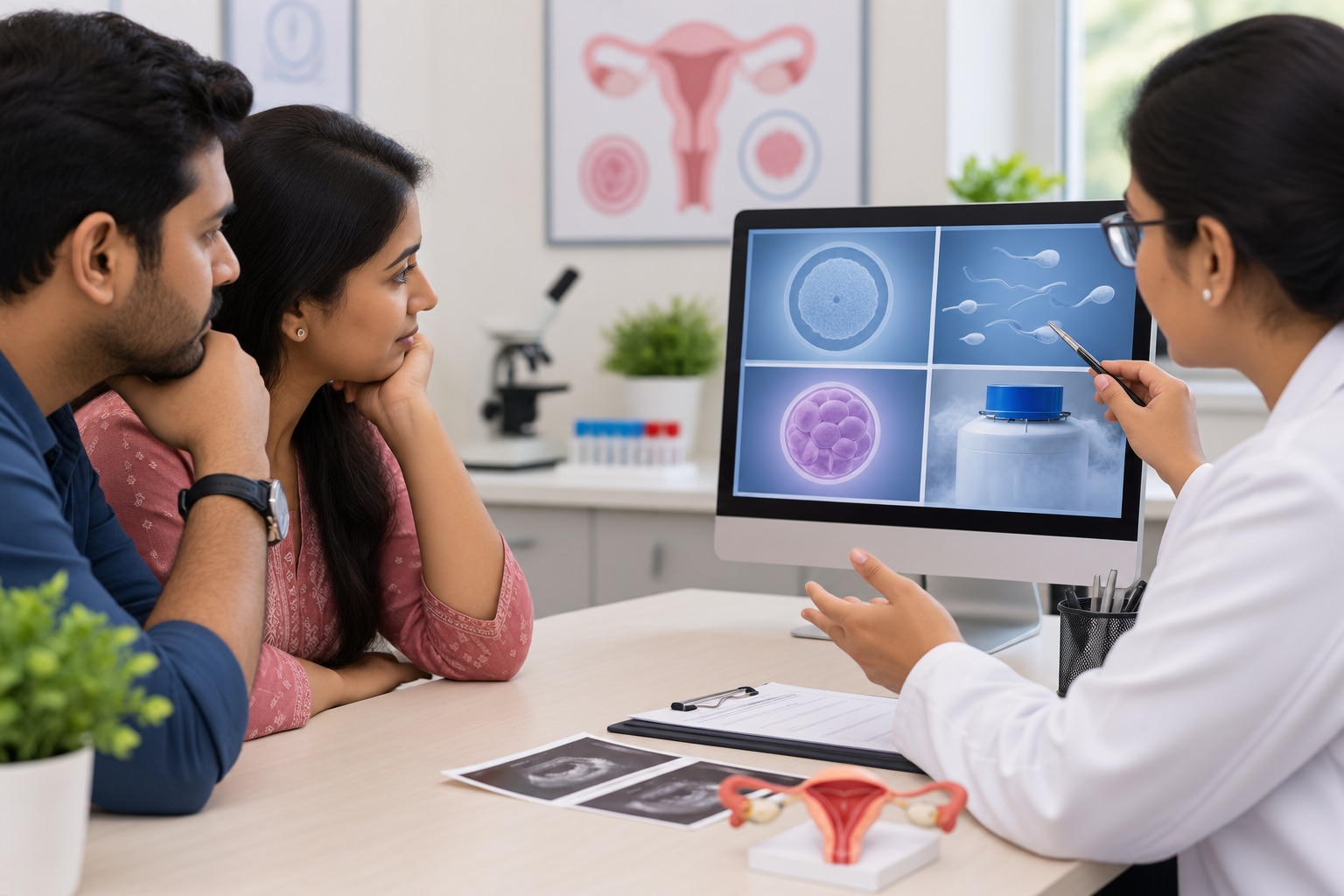
Bring your treatment timeline, diagnosis, medication list, previous semen analyses, ovarian-reserve results, operative notes, chemotherapy plan, and pathology reports to the fertility preservation consultation.
Ask what additional testing is needed: AMH and antral follicle count for ovarian reserve, day-2 or day-3 FSH and estradiol when appropriate, semen analysis, hormone tests, infection screening, and genetic testing when indicated.
Ask the infertility specialist doctor to estimate the number of eggs, embryos, sperm samples, or tissue fragments you could store, the age-specific chance of using them, and the possibility of no live birth. Compare the time, procedures, risks, and recovery:
| Option | Effort to review | Future treatment |
|---|---|---|
| Eggs | Ovarian stimulation, monitoring, trigger injection, and retrieval under sedation | Thawing, fertilisation by ICSI, embryo culture, and transfer |
| Embryos | IVF retrieval plus sperm from a partner or donor | Thawing and embryo transfer; future consent can limit use |
| Sperm | One or more semen collections, with analysis and screening | Thawing for IUI, IVF, or ICSI |
| Ovarian or testicular tissue | Surgical removal and tissue-specific risks | Specialist reimplantation or laboratory use; confirm eligibility |
At Kore Fertility Centre, use the consultation to request a written storage plan covering annual fees, permitted duration, renewal, transport, disposal, donation, death or incapacity, and separation-related consent. Confirm who can authorise future use and whether your plan includes IVF or ICSI, medication, monitoring, embryo transfer, and antenatal care.
Ask about alternatives, including trying now or using donor gametes.
Frequently asked questions
What determines which cryopreservation option is suitable?
Your diagnosis, ovarian reserve, sperm production, age, treatment deadline, and access to partner or donor sperm determine the options to discuss.
Are frozen eggs or embryos better for future control?
Embryos provide information about fertilisation, while eggs preserve more flexibility when you do not want to choose sperm now.
When is testicular sperm or testicular tissue considered?
Discuss these options when ejaculated sperm is unavailable, sperm production is impaired, or a procedure could retrieve or preserve reproductive tissue.
When should ovarian or reproductive-tissue preservation be discussed?
Discuss it urgently before cancer treatment or another therapy that could damage ovarian function or sperm production.
What should you bring to a fertility preservation consultation?
Bring your diagnosis, treatment schedule, fertility-test results, medication list, partner or donor-sperm information, and questions about time, procedures, storage, and future use.
Keywords